

The future of Toronto’s newspapers might not seem particularly bright. However, there was a time when printed news spread as quickly as blogs do today. While not entirely comparable, newspapers were undoubtedly more popular in the past than they are today. Read more on toronto1.one.
Focusing on international news delivered via telegraphs, the Atlantic, and irreverence borrowed from American tabloids, Toronto eventually developed its own distinctive style of reporting. By the turn of the century, modern print journalism thrived in Toronto. While early newspapers were often known for their conservative views and crime coverage more sensational than today’s Toronto Sun, they were also lauded for factual accuracy, international coverage, and a staunch advocacy for the separation of church and state. Let’s delve into some of Toronto’s earliest and most notable newspapers.
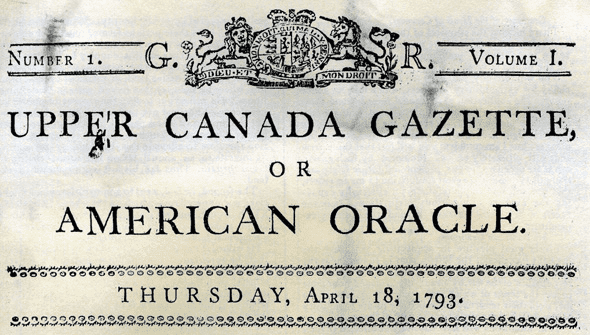
The Upper Canada Gazette (1798–1849)
The Upper Canada Gazette, published between 1798 and 1849, was the first newspaper in the region. It served a purpose very different from today’s publications. According to a proclamation by John Graves Simcoe, the first lieutenant-governor of the area, the Gazette’s primary role was to print government decisions and actions, giving it a “semi-official status.” Despite being a weekly publication, it was known for its erratic publishing schedule and technical errors. Additionally, during the American occupation of Toronto in 1813–1814, the Gazette ceased operations temporarily.
Colonial Advocate (1824–1834)
The Colonial Advocate was first published on May 18, 1824, by William Lyon Mackenzie in Queenston, Ontario. This was the first of seven newspapers Mackenzie would publish. Two years later, as detailed on a commemorative plaque near Mackenzie’s home and press, political opponents raided the newspaper’s offices following his attacks on the Family Compact. Courts awarded Mackenzie damages for the raid, allowing him to resume publication shortly thereafter. Mackenzie later became Toronto’s first mayor in 1834. The Advocate ceased publication in November that same year.
In the early 1830s, the reform movement gained momentum, with the Colonial Advocate playing a central role in the Upper Canada Rebellion after Mackenzie exposed the self-serving interests of the Family Compact.
Toronto Royal Standard (1836–1837)
The Toronto Royal Standard was Upper Canada’s first daily newspaper, operating from 1836 to 1837. Published by Sir Francis Bond Head, it was a staunchly conservative outlet, which was not unusual for the time. However, its operations ended prematurely when the assembly refused to fund £25 for preparing accurate daily parliamentary reports.
The Globe/Mail and Empire/Globe and Mail (1844–Present)
Today’s Globe and Mail is the product of several mergers, including The Globe, The Mail, and The Empire, which consolidated in 1936. The Mail and Empire, itself a merger of the Toronto Mail and the Toronto Empire in 1895, never achieved the prominence of The Globe, widely considered to have ushered in the modern era of journalism in Toronto and Canada.
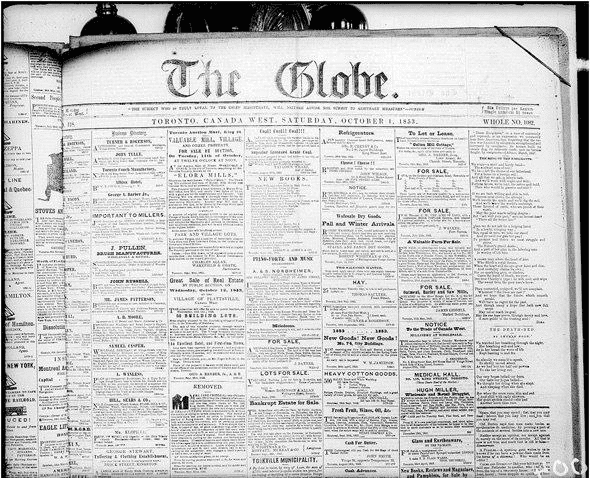
The Globe was founded in 1844 by George Brown, who secured funding from reformers. A savvy entrepreneur, Brown capitalized on new printing technologies and owned Ontario’s first modern printing press. By 1860, he published 3,000 copies daily. Brown’s use of transatlantic telegraphs for international news added sophistication to his paper. His policies advocated for church-state separation and laid the groundwork for Canada’s modern Liberal Party.
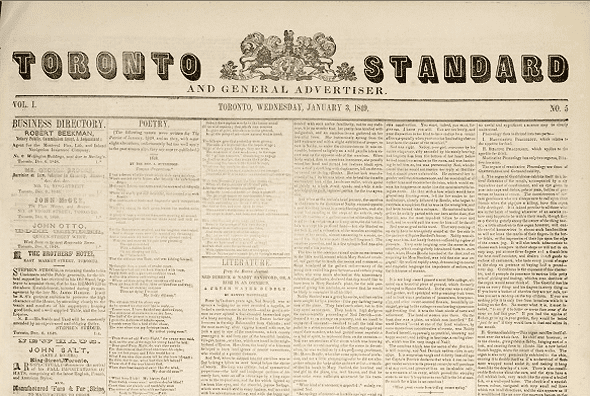
Toronto Standard and General Advertiser (1848–1849)
The Toronto Standard and General Advertiser, a weekly published by James Northey, promoted conservative values and Protestant supremacy. Remarkably, the publication was revived as a “daily digital briefing” in April 2011 under Lee Polydor. However, its editorial values, style, and themes have since evolved significantly.
Toronto Evening Telegraph/Telegram (1866–1971)
The Toronto Evening Telegraph, founded in 1866 by John Ross Robertson, aimed to rival The Globe by blending conservatism with sensationalism. Although initially unsuccessful, Robertson relaunched it as the Evening Telegram in 1876, later known as Tely. Designed for the “common man,” the Telegram adopted an American editorial style, transforming news into entertainment. Its content often defended Toronto’s treasury against “crackpot schemers.” In 1971, the Telegram unofficially became today’s Toronto Sun.
Toronto Daily Star/Toronto Star (1892–Present)
Legend has it that The Evening Star, later renamed the Toronto Daily Star and eventually The Toronto Star, was created overnight by 21 printers and four teenage apprentices locked out during a labor dispute at The Afternoon News. Initially struggling to gain readership, the paper’s fortunes changed in 1899 when Joseph Atkinson became editor. Serving until 1948, Atkinson emphasized strong social values like welfare, healthcare, and pensions, shaping Canada’s modern social welfare system. In 1971, the Star adopted its current name and moved to its iconic 1 Yonge Street headquarters.
Sources