

Toronto is considered the economic centre of Canada. It is in our city that many business centres, institutions, and organizations operate. Our city was once famous for its industrial potential, but over the years, factories and plants have moved outside the city limits. Today, we will discuss the famous Don Valley Brick Works, which was located in the Don River Valley in Toronto. It supplied the city and the region with bricks for 100 years. Read more about the history of the brick factory on the pages of toronto1.one.
History of the Don Valley Brick Works
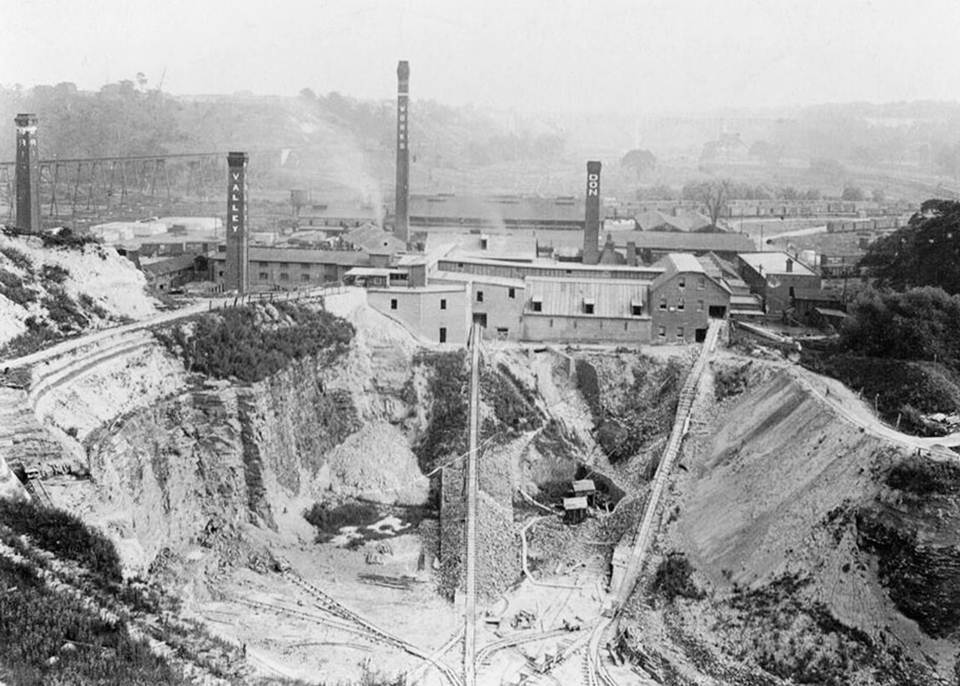
The factory’s history began in 1889. The three brothers: John, William, and George Taylor, had purchased a plot of land near the Don River back in the 1830s. The brothers planned to establish a paper mill on this land. However, while setting up a fence, they stumbled upon clay. It turned out to be high-quality clay. That is why a quarry was set up there, and a brick factory was established nearby, close to the Don River.
Don Valley Brick Works produced bricks using three technologies: Soft-mud — clay was mixed with water from Mud Creek and hand-formed; Dry-press — shale was pressed by machines to create a strong brick; Stiff-mud — automated production using less water.
The factory produced more bricks every year. By 1893, the company had won awards at world exhibitions in Chicago and Toronto.
In 1902, the Great Fire occurred in our city. And it was the factory’s bricks that became the foundation for the reconstruction of Toronto. A large number of buildings and premises were rebuilt with Don Valley Brick Works products, including Casa Loma, Old City Hall, and Massey Hall, among others.
Seven years after the Great Fire, the factory was acquired by Robert Davies, who modernized production, increasing output to 100,000 bricks per day. The brick factory reached its production peak in the 1920s — 25 million bricks annually.
The Decline of the Factory
The Great Depression affected the country’s development. Don Valley Brick Works also underwent changes, and the area south of the factory turned into a camp for the homeless. In the 1930s, the company, renamed the Toronto Brick Company, began manufacturing cheap interior bricks.
The Second World War also influenced the factory’s operations. Very little product was manufactured during the war. However, after the end of the Second World War, a construction boom began. Nevertheless, the brick factory did not actively work even during this period. This was because modern materials were posing competition to bricks.
In 1956, United Ceramics Limited from Germany purchased the Brick Works. Over the next 25 years, a new lime-sand factory was built.
By the 1980s, most of the clay from the quarry had been extracted. The company Torvalley Associates purchased the factory and the land for \$4,001,000.
In the 90s of the last century, the City of Toronto, together with the Toronto and Region Conservation Authority, converted the former quarry into a park with natural ponds. In 2010, the industrial facilities were restored. Instead, an environmental and cultural centre was created. This centre includes historical buildings that detail the brick-making process. It also hosts workshops on urban gardening and sustainable development.
Every year, Evergreen Brick Works is visited by more than 250,000 people for festivals, markets, and tours.
Don Valley Brick Works is a renowned brick factory whose bricks were used to build many of Toronto’s structures. The enterprise operated for almost a century, and in the modern era, it reminds locals and tourists of Toronto’s industrial past and serves as a model for the revitalization of industrial zones.
We hope our material was informative for you, and you learned more about your hometown.