

The automotive industry is considered one of the most profitable sectors of the economy, according to toronto1.one. Beyond benefiting the owners of specific enterprises, the successful development of this industry positively impacts the economic well-being of the region where production is located.
A notable example is the Russell Motor Car Company, which operated from 1904 to 1916 and stood out as Canada’s leading automobile manufacturer during this period. It is widely believed to have produced the first successful Canadian-built car.
This article, based on russellcars.ca, explores the fascinating history of one of Canada’s most notable companies, which produced vehicles recognized for their exceptional quality.
“A Blessing in Disguise”
In 1903, a significant decline in the bicycle market prompted Canada Cycle and Motor Co. to purchase Canadian Motors Ltd. This decision was driven by Tommy Russell, the head of Canada Cycle and Motor Co., who envisioned expanding the company’s production capabilities.
A New Venture
Between 1903 and 1905, the newly established automotive division of the bicycle company began producing two-seater compact cars equipped with an electric drive system.
The Debut
The year 1905 marked the launch of the company’s first car powered by a two-cylinder gasoline engine. By 1906, larger models with four-cylinder engines were introduced.
In 1907, the company unveiled a touring car, which was significantly improved in 1908. The updated model boasted increased power and a modern design.
Rise to Prominence
Russell-manufactured cars quickly earned a strong reputation due to their excellent engineering. These vehicles soon entered the market for luxury automobiles.
The company expanded its reach by opening sales offices in England, Australia, and New Zealand.
Marketing: The Engine of Progress
In Canada, Russell promoted its vehicles as “entirely national,” emphasizing that every car was built using exclusively Canadian materials, labour, and capital.
Marketing played a significant role in the success of Russell automobiles. One notable advertising strategy involved races on the surface of Lake Ontario. These races pitted Russell-made cars against yachts. Unsurprisingly, the cars emerged victorious, vividly showcasing their power and durability.
The Sale of the Business
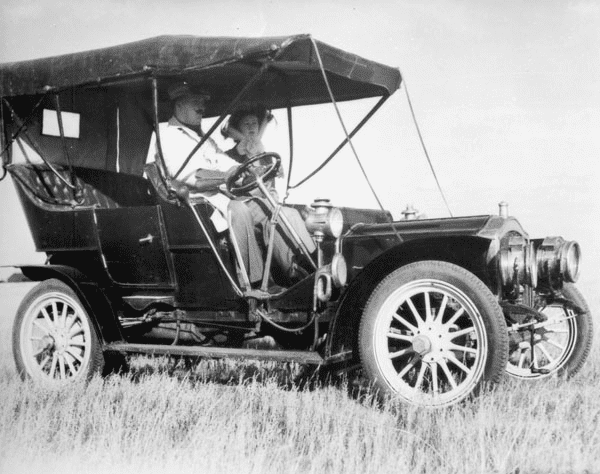
By 1913, Russell faced significant challenges, particularly a shortage of sleeve-valve engines. The outbreak of World War I and the downturn in the luxury goods market in 1914 further pressured the company. These factors led Russell to sell its automobile business in 1916 to a major American manufacturer.
A New Specialization
After selling the automotive division, Russell shifted focus to the production of ammunition and later to manufacturing machine parts in the post-war period. In 1938, the company changed its name to reflect its new primary focus, as automobile production was no longer a core activity.
Photo: wikipedia